- About
- Services
- Play
- Sport
- Case Studies
- News
- Contact
- Pitchbuilder

Tennis participation in the UK has been climbing steadily at grassroots level, and clubs and leisure facilities are under more pressure than ever to offer a surface that performs consistently, season after season. An artificial grass tennis court, built and tested to the right standard, can deliver exactly that - but "artificial grass" covers a wide range of quality, so it's worth understanding what actually separates a faultless surface from an average one.
It comes down to three things: a consistent, predictable bounce; secure footing in all weather; and a surface that still performs the same way in year eight as it did in year one. All three depend on getting the build right from the start, the turf type, the infill, and how the court is tested and certified.
A tennis-specific artificial grass system is a different product to football or rugby turf - it uses a shorter, denser pile (typically in the 10–20mm range) designed to keep the ball's bounce predictable rather than to absorb heavy impact. Most of our tennis surfaces use specialist tennis-grade turf manufactured in the UK, tested for quality and backed by a 20,000 playing-hour guarantee.
Once laid, the turf is dressed with a silica sand infill. This isn't cosmetic - the pile of a sand-filled artificial grass surface needs the sand to stay upright and supported; without it, the fibres flatten and the bounce becomes inconsistent.
Line markings matter more than people expect. We use tufted or inlaid markings - sections of coloured carpet cut directly into the surface - rather than painted lines. Painted markings wear off within a season or two on a well-used court; inlaid markings are part of the surface itself and last as long as the carpet does.
Not all artificial grass is created equal, and the way to verify quality objectively is through independent testing rather than marketing claims. The International Tennis Federation (ITF) rates every classified surface product on its Court Pace Rating - a measurement of how the ball's speed changes on impact, taken with specialist test equipment and re-verified every three years. Surfaces are grouped into five categories from 1 (slow) to 5 (fast), with most quality artificial grass tennis surfaces sitting around category 3 (medium), a balanced pace suited to club and recreational play.
Beyond the product itself, individual installed courts can apply for ITF Recognition - One-Star confirms the quality of the installation, and Two-Star additionally confirms the court's actual measured pace falls within range of its classified rating. For clubs hosting any kind of graded or competitive play, this is worth specifying at the planning stage rather than assuming it's covered.
Construction standards more broadly are set out in SAPCA's Code of Practice for tennis court construction, developed with input from the LTA, which also offers free advice to UK facilities planning a new or replacement court.
A small but genuinely useful detail: artificial grass tennis courts perform best with proper turf shoes (TF) - soles with small, closely spaced rubber studs that grip evenly without damaging the pile. Standard trainers or hard-court shoes can accelerate wear, particularly around the baseline and service boxes where movement is heaviest.
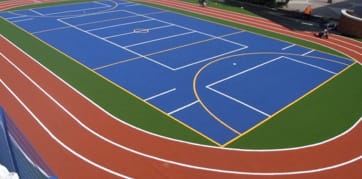
Specifications aside, a new court needs to look the part too. We've installed five tennis courts, including two junior courts, at Hutton Rudby Tennis Club, and a vibrant multi-use court at Haltwhistle Leisure Centre that doubles as a MUGA. Both are good examples of what a properly specified artificial grass court can look like in daily use, not just on paper.
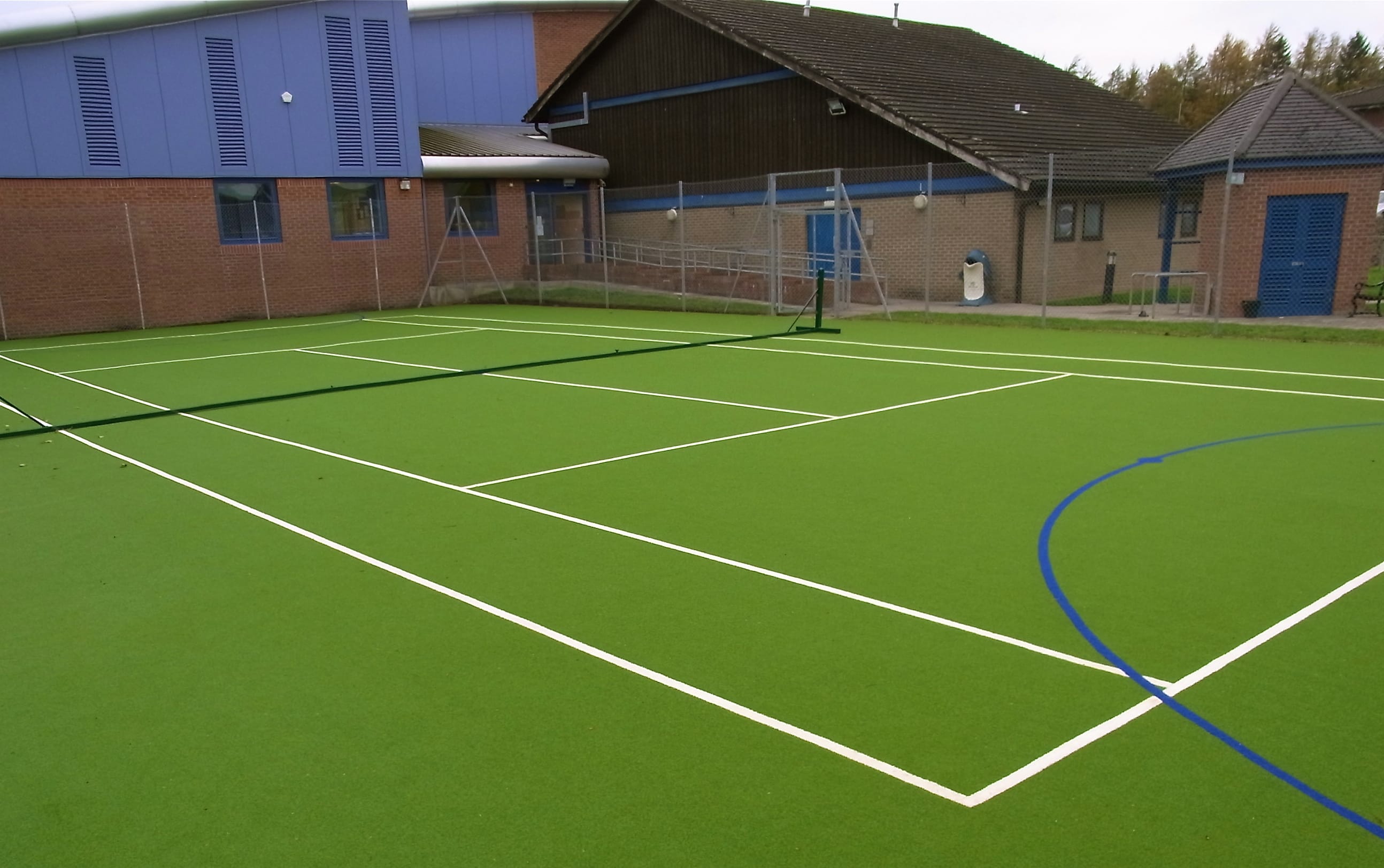
Tennis court installation at Haltwhistle Leisure Centre
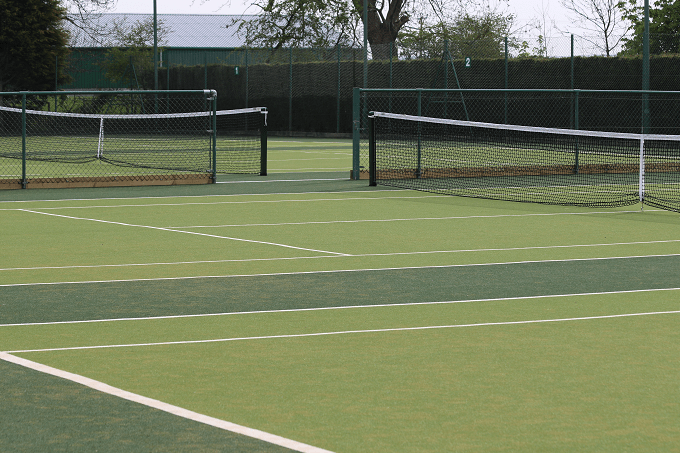
A well-built, well-maintained artificial grass tennis court typically performs for 8–10 years before resurfacing is needed, longer with consistent care. Routine brushing keeps the pile upright and redistributes infill evenly, while periodic top-ups prevent the bare patches and uneven bounce that come from sand migration. If your court is starting to show those signs, our guide on how and when to resurface your pitch covers the warning signs in detail - they apply just as much to tennis courts as football pitches.
What ITF category is artificial grass tennis turf? Most quality artificial grass tennis surfaces are classified around Category 3 (medium pace), though this varies by product spec - always check the surface's official ITF Classified Surfaces listing rather than relying on manufacturer claims alone.
Do I need ITF Recognition for my court? Only if you're hosting graded or competitive play where pace consistency needs to be verified. For general club and recreational use, a quality-tested, well-installed surface is usually sufficient.
How long does a silica sand infill last before it needs topping up? This depends on usage, but most clubs should expect to top up infill levels within routine annual maintenance - left unchecked, infill loss is one of the most common causes of an inconsistent bounce.
Can artificial grass tennis courts be used for other sports? Yes - many of our installations, including Haltwhistle Leisure Centre, are built as multi-use courts (MUGAs) that support tennis alongside other sports.
Whether you're planning a new club court or replacing a tired one, we'll talk you through turf options, ITF classification, and what's realistic for your budget - including a site visit and physical samples.
01642 713 555 | ️ info@stmworld.co.uk | Get a quote
Want to plan court layout and markings first? Try our Pitchbuilder tool.
We understand the design and construction of your pitch/court is vital. We can help you optimise your space with an extensive array of options for size, colour, markings, fencing & lighting and gate positions. We’ll guide you through the process of designing your turf, so that you can visualise your pitch/court before its construction.
Try our free pitch builder, or give us a call to talk to one of our experts.