- About
- Services
- Play
- Sport
- Case Studies
- News
- Contact
- Pitchbuilder

Yes, you can play basketball on artificial turf, although it is primarily used for practice, recreational or multi-use settings rather than professional competition.
Traditionally, basketball is played on hardwood, asphalt, or concrete. Modern synthetic turf (Astro Turf) is designed specifically for sports and is a growing alternative for backyard courts and schools. That said, if you want a more “true” basketball feel (consistent bounce, crisp footwork and regulation-style play), a polymeric basketball court surface is often the better option for outdoor hard-court performance.
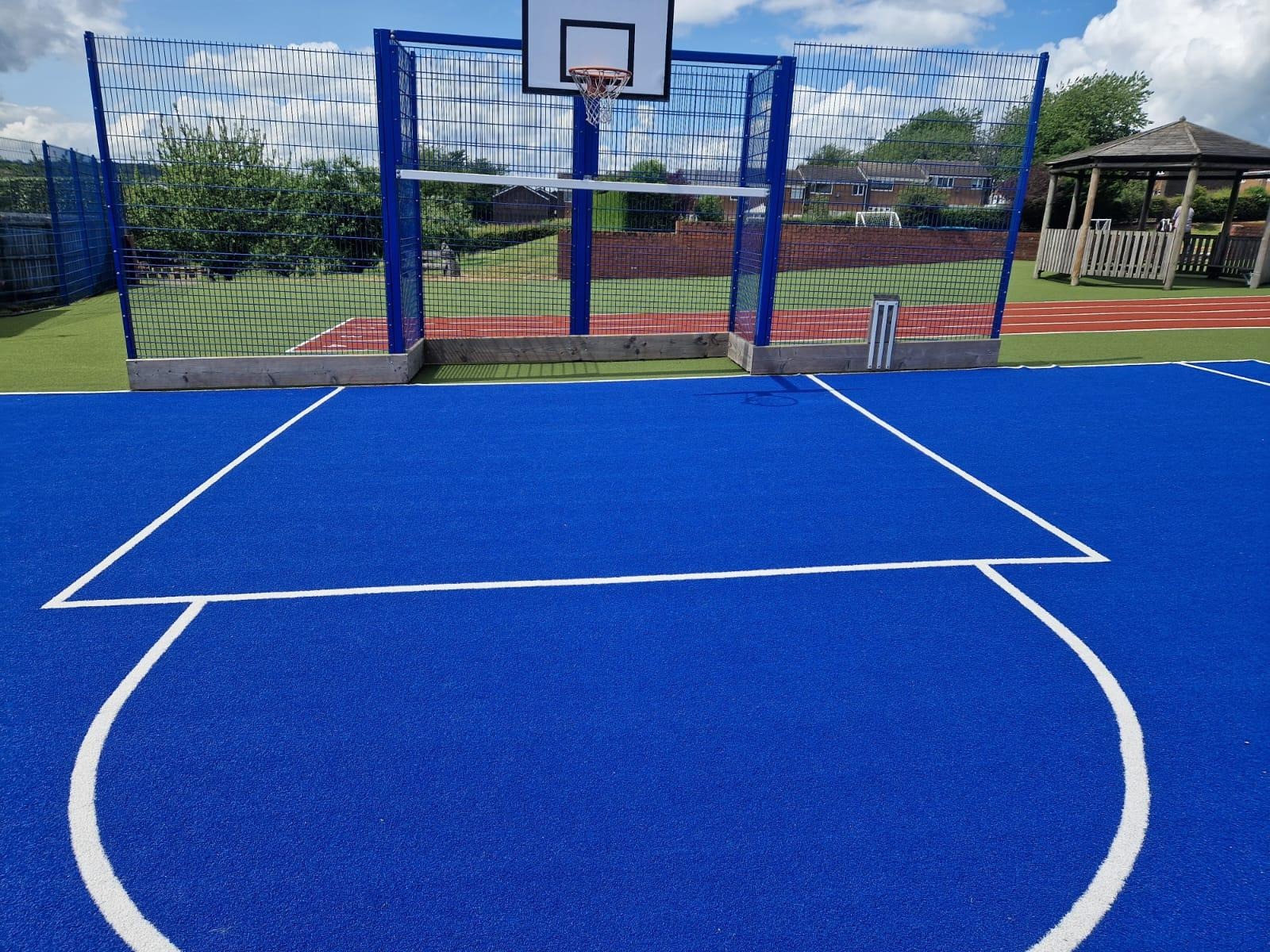
Ball Bounce: Artificial turf absorbs more energy than hard surfaces, which can lead to a lower and less predictable bounce. To mitigate this, specialized "Active Play" turf typically has a shorter (approx. 12mm), firmer pile and is installed over a compacted, flat sub-base. Polymeric courts deliver a more consistent, game-like bounce similar to traditional hard courts.
Player Safety: Synthetic turf offers superior shock absorption, reducing strain on joints and the risk of injury from falls compared to concrete or asphalt. Polymeric systems can also be installed with cushioning options (depending on the system) to improve comfort versus plain asphalt.
Traction: Many sport-specific turfs are engineered for high traction and are slip-resistant, even in wet conditions, allowing for year-round outdoor play. Polymeric surfaces are also designed for grip and can be finished with anti-slip textures for wet-weather play.
Durability: It is highly weather-resistant and does not crack in extreme temperatures like some hardcourt materials. Polymeric surfacing is built for outdoor use too, offering strong UV stability, colour retention, and a durable playing surface when installed over the right base.
For the best experience, look for these specifications:
Low Pile Height: Shorter fibers (often around 12mm–15mm) are better for ball bounce than the long blades used for football or rugby.
Macadam base – typically a stone subbase with layer of 40mm of 10mm stone and 25mm of 6mm stone open textured
Firm Sub-base: A layer of compacted MOT (crushed stone) and sand is necessary to create a hard, even surface beneath the turf.
Shock Pad: An optional underlayer that provides extra cushioning for high-impact movements.
If basketball is the main priority, consider:
Purpose-built polymeric surfacing: Designed specifically for hard-court sports like basketball and netball.
Accurate line markings: Crisp, long-lasting court lines for basketball (and multi-sport if needed).
Optional colour zones & logos: Great for schools and community facilities to boost engagement and branding.
Correct base design: A well-built, level base is key for performance and longevity.
|
Feature |
Artificial Turf |
Polymeric Court Surface |
Asphalt / Concrete |
Hardwood (Indoor) |
|---|---|---|---|---|
|
Bounce Quality |
Variable / Lower |
High / Consistent |
High / Consistent |
Optimal |
|
Joint Impact |
Low (Cushioned) |
Medium (can be cushioned) |
High (Hard) |
Medium |
|
Maintenance |
Minimal |
Low–Moderate |
Moderate (Resurfacing) |
High (Waxing) |
|
Weather Use |
All-Weather |
All-Weather |
Weather-Affected |
Indoor Only |
Are you considering this for a basketball area at your school- and is it mainly basketball-first, or a multi-use (MUGA) space? Contact us today for your free quote.