- About
- Services
- Play
- Sport
- Case Studies
- News
- Contact
- Pitchbuilder

Choosing the right tennis court surface affects how the court plays, how often it can be used, and how much maintenance it will need over time. Whether you are managing a school, running a sports club, maintaining a community facility, or installing a court at home, the surface choice has long-term implications.
In the UK, the most common options are macadam (hard courts) and artificial grass. Both surfaces are suitable for tennis, but they perform differently and suit different priorities. At STM, we specialise in artificial grass tennis courts because they offer practical benefits for a wide range of users.
Quick Comparison: Macadam vs Artificial Grass Tennis Courts
| Factor | Macadam (Hard Court) | Artificial Grass |
|---|---|---|
| Maintenance | Relatively low on a day-to-day basis, but requires regular cleaning and periodic resurfacing or crack repairs, typically every 5–10 years. Moss and algae can develop in shaded or damp areas. | Minimal routine upkeep such as brushing to keep fibres upright and clearing debris. Occasional deep cleaning or infill top-ups may be required. |
| Durability | Highly durable and resistant to heavy use, but prone to cracking over time due to ground movement or temperature changes. | Designed for heavy use and long-term performance. Typically lasts around 12 years before full replacement when properly maintained. |
| All-Weather Play | Drains well and dries quickly, allowing play soon after rain. | Performs consistently in wet or dry conditions and remains usable when natural grass would be unsuitable. |
| Suitability for All Abilities | Provides a fast, firm, and consistent bounce, which suits coaching and competitive play. The hard surface can be less forgiving on joints and falls. | Offers a softer, more cushioned surface that is easier on joints and safer for falls, making it suitable for all ages and abilities. |
Macadam tennis courts provide a firm and predictable playing surface. They are commonly used at tennis clubs, schools, and some private properties where fast-paced play is preferred. Players often value the consistent bounce, which supports coaching and technique development.
However, macadam surfaces are not maintenance-free. Over time, cracking can occur due to ground movement and weather conditions. In areas with limited sunlight or drainage, moss and algae growth can affect grip and appearance. These issues require cleaning, repainting, and eventual resurfacing to maintain safe play.
Macadam surface requires planned long-term maintenance to remain in good condition.
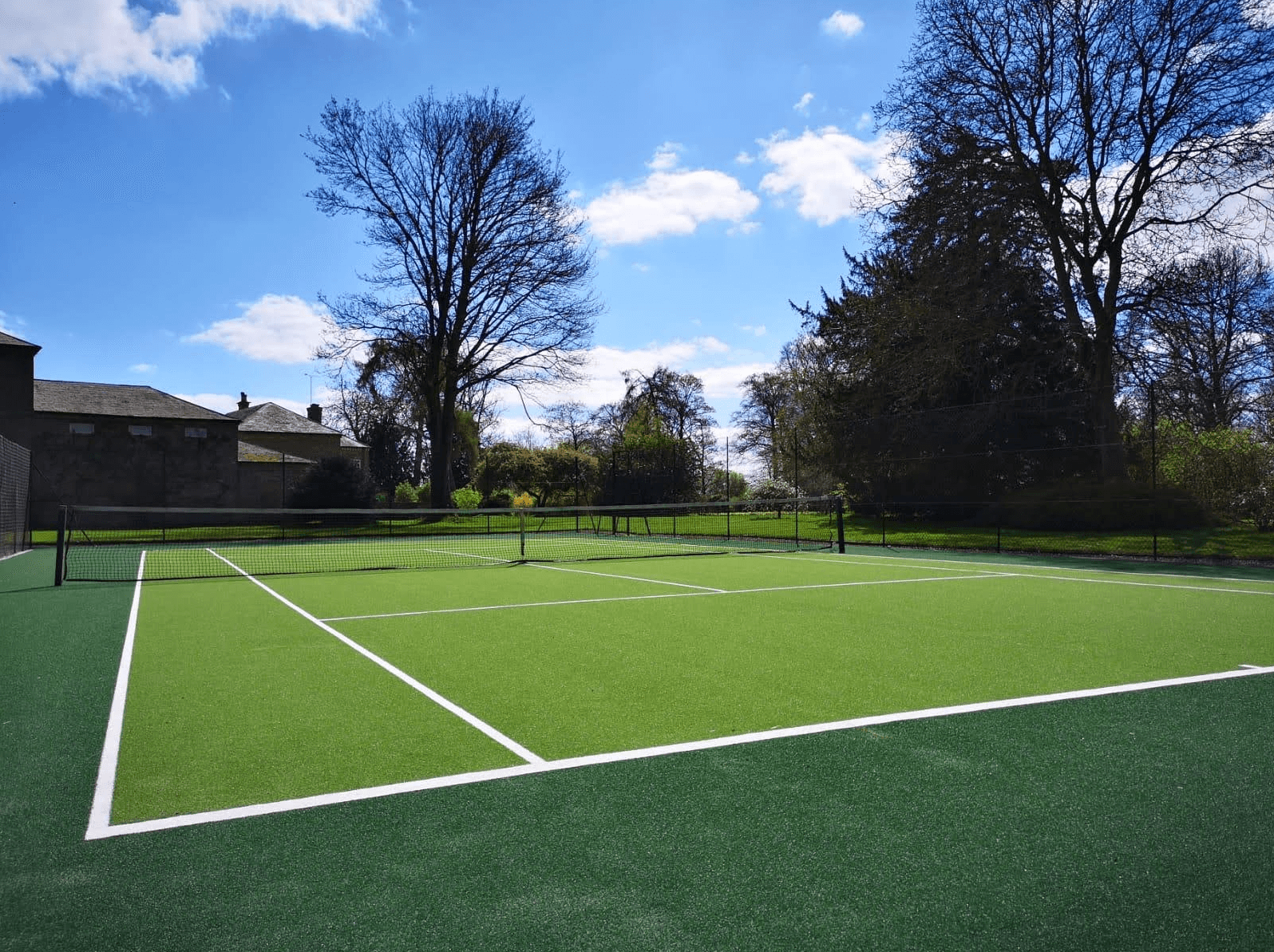
Artificial grass tennis courts deliver consistent performance with reduced maintenance demands. These surfaces replicate the appearance of natural grass while offering a more controlled and durable playing environment. Artificial grass courts are suitable for schools, clubs, community facilities, and private homes where regular use is expected.
The surface is softer than macadam, which helps reduce strain on joints and lowers the impact of slips and falls. This makes artificial grass a practical choice for families, junior players, recreational users, and mixed-ability groups. Depending on the system, artificial grass courts are also approved for play under International Tennis Federation guidelines.
Artificial grass surface supports regular use with less surface deterioration.
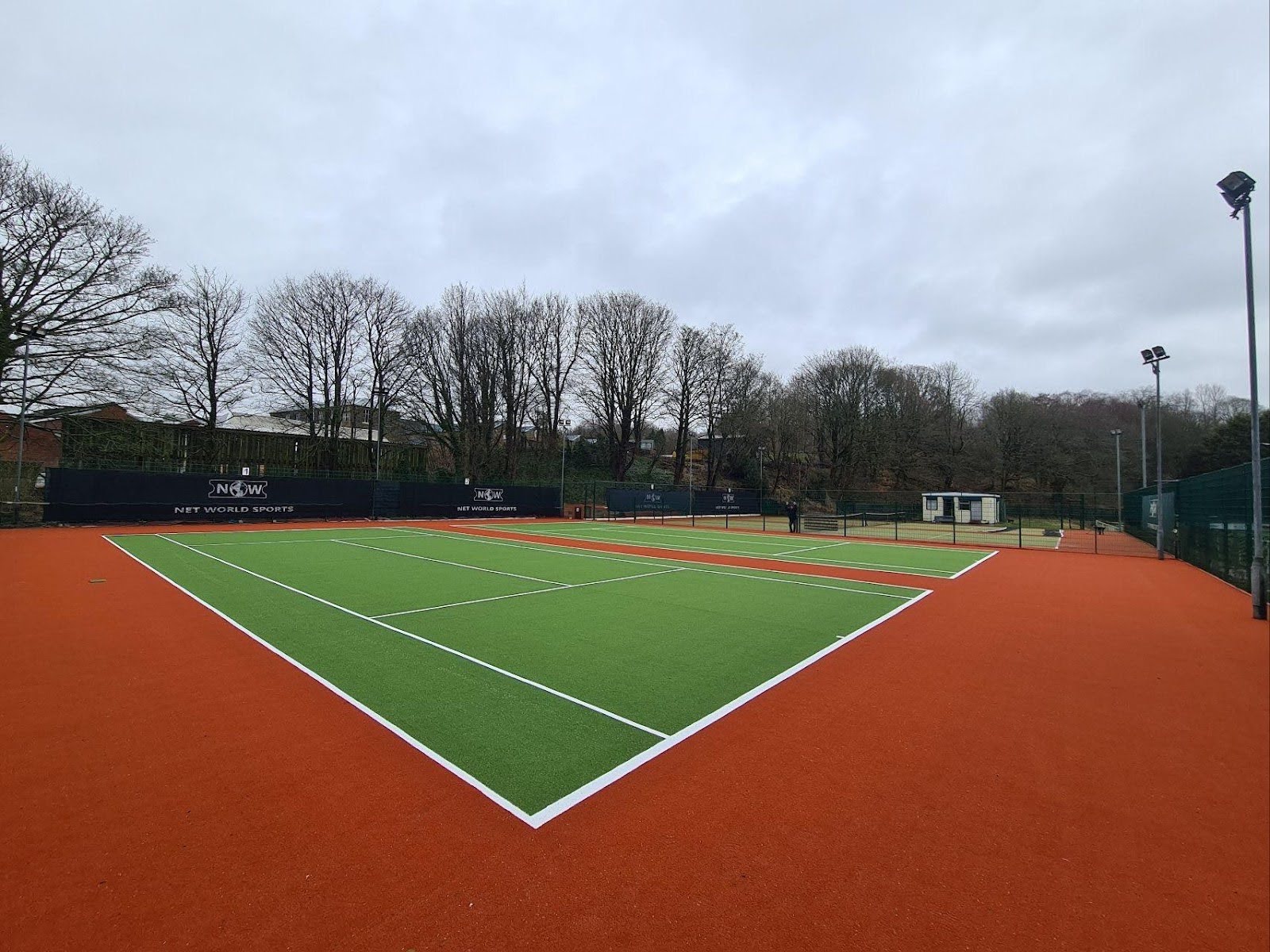
Surface choice affects lifetime cost. Macadam courts generally have a lower initial build cost, but resurfacing, repainting, and crack repairs add up over time. Artificial grass may involve a higher upfront investment, particularly when installed over a tarmac base, but ongoing maintenance is lower and more predictable.
For many facilities and private owners, artificial grass becomes cost-effective over its lifespan due to reduced disruption and fewer major repairs.
Tennis court use varies by setting. Clubs focused on competitive play may prefer macadam. Schools often need a surface that supports both tennis and general sports use. Community facilities value durability and year-round access. Private homeowners usually want a surface that looks good, feels comfortable, and is easy to maintain.
Artificial grass meets these needs more consistently across different user types, which is why it is increasingly chosen for new and replacement courts.
There is no single tennis court surface that suits every situation, but artificial grass offers clear advantages for most users. It provides reliable play, improved comfort, lower maintenance requirements, and long-term durability. While macadam remains a suitable option for specific applications, artificial grass tennis courts offer greater flexibility for schools, clubs, community spaces, and private homes.
Tennis court surface choice determines playability, maintenance demands, and long-term value.
To conclude, if you would like a little more information on a tennis court surface, then contact our team today on 01642 713 555 and we will be happy to talk you through the process, send you some samples and come out to measure the area.
We understand the design and construction of your pitch/court is vital. We can help you optimise your space with an extensive array of options for size, colour, markings, fencing & lighting and gate positions. We’ll guide you through the process of designing your turf, so that you can visualise your pitch/court before its construction.
Try our free pitch builder, or give us a call to talk to one of our experts.