- About
- Services
- Play
- Sport
- Case Studies
- News
- Contact
- Pitchbuilder

Schools rely on their playground surfaces every day for breaktimes, PE lessons, and outdoor learning. The surface needs to perform consistently, support pupil safety, and remain usable throughout the school year. Natural grass often struggles under regular use and poor weather, which leads to muddy areas, closures, and ongoing repair work. Artificial turf provides a practical alternative that supports daily use while reducing maintenance demands. Artificial turf delivers reliable performance for school playgrounds when designed and installed correctly.
Contact STM to discuss artificial turf options for your school playground.
Artificial turf maintains surface stability in wet and cold conditions. In many schools, grass areas become unusable during autumn and winter due to rainfall and heavy foot traffic. This can limit outdoor play and reduce access to physical activity. Artificial turf systems are designed to drain efficiently and remain firm underfoot, allowing pupils to use the playground throughout the year with fewer interruptions. This makes it easier for schools to plan outdoor time without relying on weather conditions.
Playground surface supports pupil safety when evenly installed and maintained. Artificial turf removes common risks associated with grass, such as holes, uneven ground, and muddy patches. When combined with an appropriate shockpad system, artificial turf provides a predictable level of impact absorption. This consistency is important in school environments where large numbers of pupils use the space every day under supervision.
Artificial turf reduces routine maintenance tasks. Natural grass requires mowing, watering, fertilising, and regular repair, all of which place pressure on school budgets and site teams. Artificial turf removes most of these ongoing tasks and helps schools manage outdoor spaces more efficiently. While periodic cleaning and maintenance are still required, the overall workload is lower and more predictable over time.
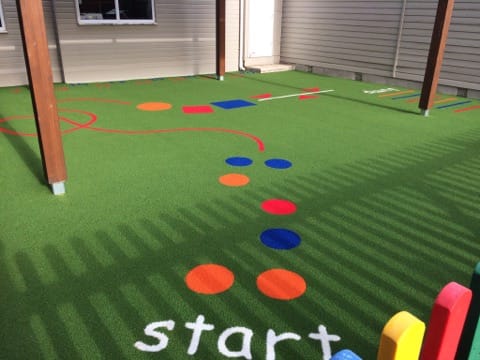
Playground surface enables flexible use of outdoor space. Artificial turf is suitable for free play, PE activities, sports sessions, and structured outdoor learning. Schools can include line markings, colour zones, or activity areas to help organise play and learning. This flexibility allows schools to get more value from a single surface and supports a wider range of curriculum and enrichment activities.
Surface condition affects accessibility for pupils and staff. Uneven or degraded ground can make it difficult for wheelchair users, pupils with mobility needs, or staff using pushchairs or equipment. Artificial turf provides a smooth and level surface that supports inclusive access across the playground. This helps schools meet inclusion goals and ensures outdoor spaces can be used by everyone.
Artificial turf withstands high levels of daily use. School playgrounds experience constant foot traffic, often from hundreds of pupils each day. Artificial turf is designed to cope with this level of wear without forming bare patches or uneven areas. When correctly installed and maintained, it provides a long service life and consistent appearance, making it a durable solution for busy school sites.
Artificial turf offers schools a reliable playground surface that supports safety, accessibility, and year-round use while reducing maintenance demands. It provides consistent performance, adapts to multiple activities, and stands up well to daily use in busy education settings. Artificial turf adds long-term value when selected as part of a well-planned playground solution. For schools looking to improve outdoor spaces in a practical and sustainable way, artificial turf is a proven option.
Speak to STM today to plan an artificial turf playground that works for your school.